
Spokane Valley Previous-Resident Sources
The record trail for previous residents of a Spokane Valley address is uneven. County assessor history has a stated start date, but the recorder does not publish one online-index start year. Directory runs are selective. Census schedules lag the present under federal release rules. The right first source depends on the period, and no one row proves both ownership and occupancy.
| Source | Years It Covers | Where Held | What It Shows |
|---|---|---|---|
| Assessor and SCOUT | Back to 1996 | Spokane County Assessor | Parcel, situs, status, property type, tax and ownership context |
| Recorded-document index | Online start not stated | Spokane County Auditor | Conveyance trail, document number, date, and legal description |
| Plats and surveys | 1880–2026; current year incomplete | Washington Digital Archives | Addition, lot, block, survey, and legal-description context |
| Suburban directories | 1983–84 and selected years through 2000 | Spokane Public Library | Dated name, address, household, telephone, or business clues |
| County directories | 1954–84, 1986–87, 1992, 1994–98, 2000–04 | Washington State Library | Historical name and address entries |
| Federal census | Released schedules under the 72-year rule | NARA, Census, and library microfilm | A household snapshot for one census date |
| Permits | Start date not located | Spokane Valley SmartGov | Application, work, issue, final, and inspection context |
For a recent trail, start with SCOUT and the newest deed. For a mid-century address, add county directories, Sanborn research, and released census schedules. Use plats when the parcel was divided or combined. The Spokane Valley Heritage Museum is the strongest local fallback for phonebooks, newspapers, schools, businesses, and township records.
Start Spokane Valley Resident Records
Open the Spokane County SCOUT search with the current street address. The public prompt accepts a parcel or address. Save the parcel number, exact situs address, property type, Active or Inactive status, and legal description shown by the official result. Situs means the physical location recorded for the parcel; it is not the same as an owner's mailing address.
The assessor states that its property records reach back to 1996 and that ownership changes must be recorded with the Auditor. It also explains that a legal description names the land bought or sold, while a parcel number is an administrative key. That distinction protects the trail when a street label changes.
Note: Do not call a parcel owner an occupant unless a second dated source places that person at the address.
Trace Spokane Valley Property Records
The Spokane County Auditor recording index is the discovery path for the deed chain. A grantor gives or transfers an interest; a grantee receives it. Start with the latest owner and legal description, locate the newest conveyance, then turn the seller into the next backward search name. The index helps locate a document, but the deed image or certified copy is the evidence.
- Copy the current parcel identifier and legal description from SCOUT.
- Use the public recorder login and the fields shown there to find the latest purchase deed.
- Record the instrument number, recording date, document type, grantor, grantee, and legal description.
- Search the seller as a grantee to find that party's earlier acquisition, then repeat.
- When an image or index path ends, ask the Auditor about public computers, books, microfilm, or a copy search.
- Grantor and grantee
- The party transferring an interest and the party receiving it.
- Chain of title
- The linked sequence of recorded transfers for the same land.
- Legal description
- The deed or plat description that can persist when an address or parcel number changes.
Recording numbers before June 3, 1996 use ten digits with volume and page. Later recordings use seven digits without volume and page. This is a format change, not a proven online start date. Never claim all earlier deeds are searchable on the web.
The official recorder capture shows the public search entry for recorded instruments.
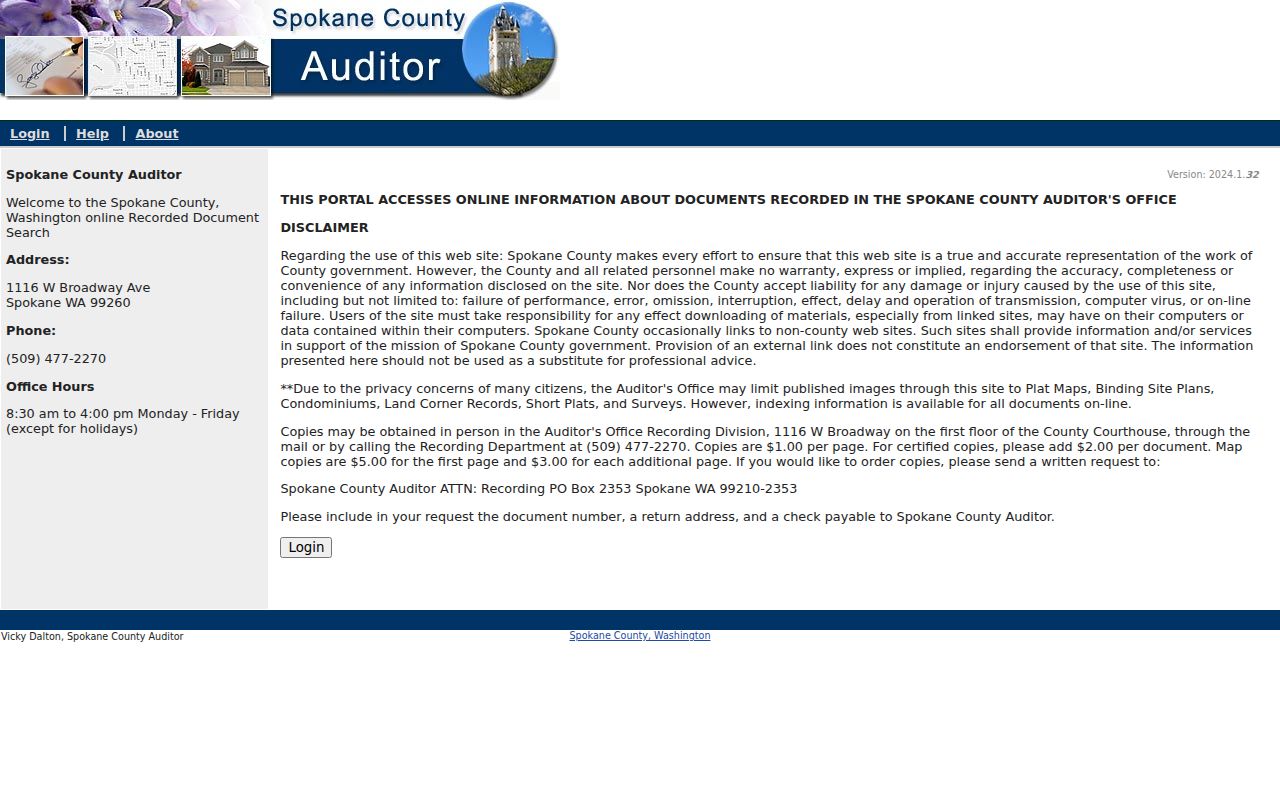
If a deed image is withheld or missing, use its recording number to request the record from the Auditor at 1116 W Broadway in Spokane or by phone at 509-477-2270.
Bridge Spokane Valley Address Records
The Spokane County Auditor Plats and Surveys title in Washington Digital Archives reaches from 1880 through 2026, with the current year incomplete. The inspected title listed 15,616 records. Search by party or company, first and middle name, Soundex, party type, addition name, and year range. Record types include plats, short plats, surveys, condominium plats, miscellaneous maps, and binding site plans.
The archived portal capture provides a visual checkpoint for that map and plat collection.
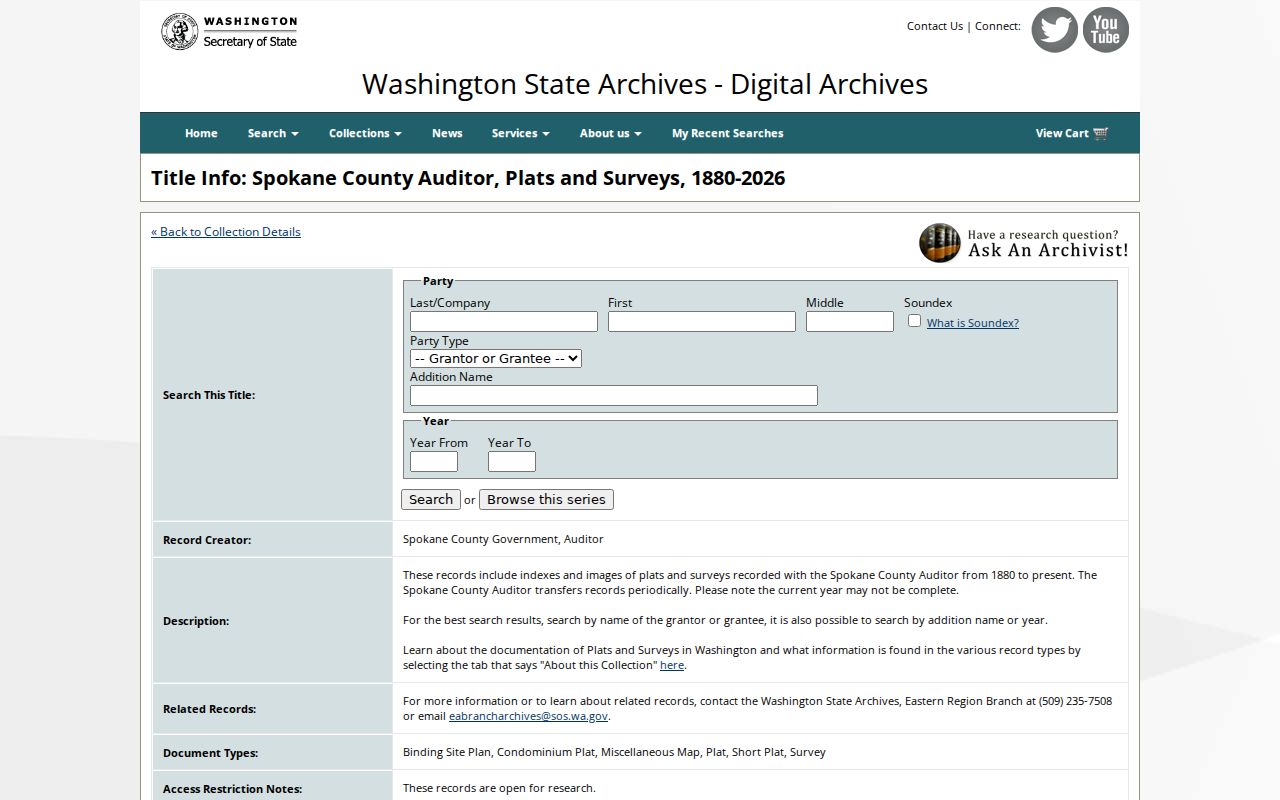
Use the addition, lot, block, survey, or boundary adjustment to reconnect a deed trail after a parcel split. A party named on a plat is not automatically a previous resident. The map proves a land-record connection only within its date and record type.
Spokane Valley Historical Directory Gaps
Spokane Valley's address trail can break without any formal loss of records. A modern parcel may once have appeared under Opportunity, Veradale, Trent, Dishman, Yardley, Greenacres, or Millwood. Street suffixes and directional prefixes vary. Rural routes may replace street forms in early sources. Parcel splits can also move the useful key from an address to a plat.
Search the original form, reasonable formatting variants, the historical community, the addition or legal description, and nearby cross streets. No verified Spokane Valley renumbering project year was found in the official research. Do not invent a conversion date. Resolve an apparent mismatch with a dated plat, official map, deed, directory, or local historian.
Best bridge. Match the legal description across a deed and plat, then compare the dated address in a directory or newspaper.
Spokane Valley Resident Archive Research
The Spokane Valley Heritage Museum holds the strongest locally focused fallback for previous residents. Its archives list the Spokane Valley Herald from 1920 to 1983, school records from 1892, yearbooks, phonebooks, oral histories, business records, and township material from Opportunity, Chester, and Greenacres. It also has Spokane Valley Today for 1979 through 1998 and other regional files.
The museum publishes a $50 flat charge for an extensive research request, including documents or images, plus separate copy and shipping fees. Give staff the address variants, legal description or addition, surname, school, business, and date range. The broader archive area extends beyond today's city limits, so preserve the locality used by each item.
Date Spokane Valley Address Records
Sanborn fire maps, directories, plats, and permits answer different parts of a building's history. Official historic-preservation research cites Spokane directory work for 1891, 1902, 1910, 1925, 1930, 1940, 1950, and 1960 alongside Sanborn maps and census sources. Those dates identify a research set, not a complete digital collection.
For newer work, Spokane Valley SmartGov Advanced Search accepts application number, type, status, submitted, issued and final dates, site address, city, ZIP, parcel, primary contact, and primary contractor. Its official start year was not located. A permit can date construction or alteration, but the applicant or contractor is not proof of occupancy.
Confirm Spokane Valley Past Households
Owners are only one layer. A reverse or criss-cross directory may arrange entries by street address, while a surname section may place a named householder there. Released census schedules can show a household on one census date. The available Spokane suburban directories begin with 1983–84 and continue in selected years through 2000; county holdings cover several runs from 1954 through 2004. Collection details belong on the Spokane Valley city directory page.
Use a simple flow: address in a dated directory, household in a released census schedule, then name and date in a newspaper or obituary index. A missing name may reflect a gap, move, variant spelling, unlisted household, or changed locality. Do not force the records to agree.
- Choose a directory year closest to a released census date and transcribe the address entry.
- Find the census enumeration district, the area used to organize census pages, from maps or location tools.
- Compare names, ages, relationships, and place details without treating spelling alone as a match.
- Move to adjacent directory years to narrow an arrival or departure.
- Use an obituary, cemetery source, or probate case to close a historical endpoint.
Probate files may identify a decedent, estate representative, heirs, or property, but they are court records and may be restricted in part. Request them from the proper court custodian, not the general county records portal.
Lawful use. Research previous residents for house history, genealogy, estates, or personal curiosity. Never use a historical trail to track, harass, or harm a living person.
Log Spokane Valley Resident Evidence
A backward trail is easiest to audit when every claim keeps its custodian and date. Create one row per source with the parcel or legal description, instrument number, recording date, grantor, grantee, directory year and page, census citation, and the next prior search term. Branch the notes when a parcel was subdivided or combined.
Separate three conclusions: who owned the land, who appeared at the address, and what happened to the building or parcel. A deed supports the first. A directory or census may support the second. A plat, Sanborn map, or permit supports the third. Agreement among independent dated records makes a stronger Spokane Valley previous-resident finding than any one name search.
Note: Preserve a rejected same-name match and the date or address that ruled it out; it can prevent a false link later.